


By Duston Barto
For many years I’ve been watching ripples across the surface of our society as isolated events became connected causes and grew into an overwhelming feeling of unrest and dissatisfaction with the apparent injustices of our society. I have seen racism’s ugly head rise out of the ashes again like a perverse phoenix, then merge with xenophobia, Islamophobia, and other systems of oppression. This has caused people in minority groups of ethnicity, faith and political view to become consistently steamrolled by an engine of hate and malcontent. Therefore, when I first heard the call from Minister Louis Farrakhan for a gathering on America’s front lawn in Washington, DC; I kept my eyes and ears open.
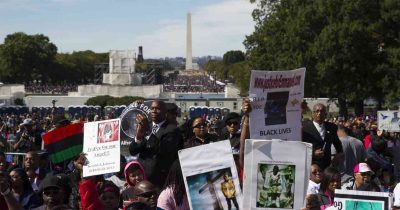
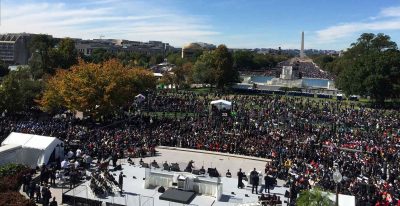
In order to mark the 20th anniversary of the famous Million Man March on October 10th, 2015; The Nation of Islam leader had declared a gathering to raise the call for justice in our society. Under the banner, Justice … Or Else, people from all walks of life responded to the announcement. Christians, Muslims, Black, Latino, Native American, and White activists all agreed that a large gathering was needed to show the hatemongers that the will of people to live free from oppression will not be broken.
Imam Khalil Akbar from Masjid Ash-Shaheed shared his thoughts with me, “Twenty years ago I didn’t see the benefit of calling a million people together just to voice a concern, I thought that the energy should be spent going to clean up the community. This time, however, I feel that the objectives of the march are good.” He also felt the rising tide of hate as he said, “Racism, police brutality and many other issues that we faced in the 1950s and 1960s have reared their ugly heads again and it’s time for Muslims to wake up and join the call for justice.”
Activist Kimberly Khalimah Songstress also voiced some frustration regarding Muslim activism, she expressed, “I attended Jummuah on Capitol Hill, an event that has been held annually since 2009 to bring awareness to the concerns of the Muslim community as a whole.” However, she was amazed to find mostly members of the Nation of Islam present, “What struck me the greatest was the absence of “Orthodox” Muslims. We were virtually nowhere to be seen.”
Afzal Syed, board member of MAS Charlotte answered the call because, “There has been a rise in exaggerated fear and hate of Islam and Muslims that has increased the racial and religious discrimination. All communities and faiths should come together to fight any discrimination against any human being.”
Jonathan Nazeer, also active with Masjid Ash-Shaheed, said “As a father of three boys and a girl, when I think of their future and their sense of pride in themselves; it was important for me to go and address the concerns of the Black community and the community as a whole.” Jonathan referenced the recent high-profile police violence and concluded, “As a father, I’ve got to be concerned with my children’s safety. This whole system has to be re-evaluated.” Jonathan feels that the issues of injustice should hit everyone, “This wasn’t a Nation of Islam event, even though the call came out from Minister Farrakhan, the organizational committee was filled with Christians.”
In fact, some of the primary organizers included Dr. Jamal Bryant from the AME Zion Church, Willie Wilson who is pastor of the Union Temple Church in Washtington DC, and Tamika Mallory who is the former Executive Director of the National Action Network. “Justice or Else is not just for African Americans,” says Afzal Syed, “this could be related to the Muslim community, the Hispanic community or any other community or group.”

Student Minister Corey Muhammad of Muhammad Mosque 36 in Charlotte said “Even if I wasn’t a student minister in the Nation, when I see the injustice presented by the police and the court system, I have to stand up.” Corey agrees that the demand for justice is universal, “Justice doesn’t have a religion or a creed, standing for justice is essential as a human being.”
I asked Student Minister Corey about his sense of justice in society and he explained in detail, “Justice, according to the honorable Elijah Muhammad, is a principle of fair dealing with one another. There is a cry coming out for justice from many ends of global society, not just in the Black community. Even veterans are crying out for justice because they can’t even get adequate healthcare after serving. The universal cry for justice is heard overseas in events like the Arab Spring.”
I wanted to know more about the part that the Nation of Islam directly played in this event, Student Minister Corey said, “In 1995, Minister Louis Farrakhan made a call for a million black men to come, this challenge was a reconciliation to help change men and make them better fathers, brothers, sons and overall better men. It was to enhance the view of Black men by media which did, and does, depict Black men in a negative way.” Corey Muhammaed explained that things haven’t really improved much, “Now, 20 years later, we see gross injustice being met by Black men, Latinos, Native Americans, poor White people, etc.” As a response to this injustice, Corey Muhammad informed me that the Nation of Islam set up local organizing committees nationwide to integrate with the interfaith communities of oppressed peoples and motivate people to not only move to Washington on the 10th of October, but to continue the work at the community level nationwide. The goal of The Nation of Islam for establishing these committees was to integrate people from different races, political views and economic levels toward the betterment of society.
A Mission for the African-American Community
Of course, much of the speeches made were directed toward African Americans, Student Minster Corey said “There was a call for 10,000 fearless men and 10,000 fearless women that was specifically directed to the African American community in order to stand between the guns and the violence in our community, to set up conflict resolution centers and to drive down overall violence and the Black-on-Black crime.”
Imam Khalil said “The OR ELSE part of the gathering was not a call to violence; it was a call for the community to rise up and create a solution.” Jonathan Nazeer explained, “Sometimes in our own communities we feel isolated and feel like we’re the only ones trying to make a change. By going [to Justice or Else], you really get a sense that you are part of a large community that wants to see our society and the Black community as a whole, flourish.”
Another solution expressed was the use of economic withdrawal, a tool that Dr. Martin Luther King used. The concept, as explained to me by Student Minister Corey Muhammad, is to completely eliminate all non-essential spending from Black Friday until the end of the year. The idea is to remove money from the economy during a period when large companies usually make half of their annual income. This sort of behavior draws money out of oppressed communities and feeds into the parts of society which are most likely to be the source of oppression.
Why Should We Join with Minister Farrakhan?
Many Muslims that I talked with in the weeks leading up to Justice Or Else, expressed that they were skeptical of joining with the Nation of Islam for such an event. These thoughts were echoed from the lay person up to leaders of national organizations. After seeing the crowds of hundreds of thousands of people gathered for the single voice of shutting down injustice I couldn’t help but feel that, on a national level, we missed out on being a part of something grand. So I asked everyone I met to express why they felt Muslims should have been involved.
“Those believers who sit at home and receive no hurt are not equal to those who strive and fight in the cause of Allah with their goods and their persons. Allah has granted a grade higher to those who strive and fight with their goods and persons, than to those who sit at home. To all has God promised good, but He favors those who strive and fight, above those who sit at home, with a special reward.” – Holy Qur’an 4:95
Kimberly Kalimah says “As Muslims we are told to speak against injustices. We are encouraged to be a good example. Sure, we are not to be misled in issues of aqeedah; but in missions of respect and fair treatment of humanity as a whole, just having speeches and lectures with no follow-up or action places us in the realm of being a backseat driver.” She concluded, “If we don’t feel compelled to join their efforts, we should start our own or support the many that already exist.” She then cited 4:95 from the Holy Qur’an.
Imam Khalil Akbar said “Listen, Muslims in general suffer from issues of injustice. Since 9/11 many of us have awakened to the reality of injustice. Before that, many of our immigrant brothers and sisters had no interest in civil rights, social justice or even interfaith meetings. But when everything changed then it pushed these needs into the forefront! Now we have CAIR and other organizations encouraging people to stand up and fight for their rights to assert the position of justice and equality.” He then expressed that the cause is not new, “We aren’t joining a bandwagon when we join with these groups, we are joining the sunnah of the Prophet Muhammad (SAWS) as he joined with others to advocate for justice and equality.”
Afzal Syed shared, “Every human being has rights. Islam is against any form of racism and bigotry. There may be differences in religious aspects and some may find some things controversial in Minister Farrakhan but he is on point and has been outspoken on social issues to bring everyone to unity. Muslims should develop a relationship with friends from all faiths on a persona level and work towards social needs. Racism is ugly and it divides people. The Prophet Muhammad (SAWS) mentioned in his final sermon ‘All mankind is from Adam and Eve, an Arab has no superiority over a non-Arab nor a non-Arab has any superiority over an Arab; White has no superiority over Black nor does Black have any superiority over White except by piety and good action.”
Jonathan Nazeer echoed the sentiment when he said, “No one is asking anyone to follow Minister Farrakhan; the Minister has a good starting point, and if it is for good then does it really matter who brought it to the table? If I’m hungry and someone brings a meal, am I going to ask whose hands prepared the meal?” People should not get hung up on the person of Minister Farrakhan according to Jonathan, “The message is justice for all people. Everyone deserves an equal playing ground.”
Jonathan shared wisdom given by Imam W. D. Muhammad many years ago as he said, “There are certain aspects of the Nation of Islam that the new community [meaning the community he guided in 1975 toward Sunni Islam] should never have abandoned and these two communities should remain close.”
Student Minister Corey Muhammad closed our conversation by saying “The most powerful weapon in our arsenal is our unity backed by the might of almighty Allah / God. Justice is a great principle of fair dealing; justice is what distinguishes between right and wrong. As Muslims, when we see injustice, we are obligated to do something about it; whether it is speaking out against it, writing against it, but doing anything other than sitting idly by.”
For further information, visit www.justiceorelse.com


